|
|
| Violence-Diplomacy strategy |
Palestinian leaders from both Fatah and Hamas argue that terror -- including suicide terror against Israel, which they call “resistance” or “armed struggle” -- is as a valid political tool, and should be combined with diplomacy. They refer to violence as “seeding,” which is followed by diplomacy; i.e. stopping terror in order to let diplomacy reap the fruits of the terror. Palestinians have argued that in recent years this tactic has proven to be a successful strategy.
Fatah say that Yasser Arafat represents the model, the “expert on the timing of seeding the [armed] struggle and reaping diplomacy.” [Al-Hayat Al-Jadida, Nov. 9, 2006]. Hamas argues that it has succeeded: “Praise to Allah, we [Hamas] have demonstrated glowing success in combining diplomacy and resistance.” [Hamas representative Ayman Taha, Al-Rissala, May 17, 2007].
Most importantly, the use of Palestinian terror is seen as a function of its profitability and the PA’s capabilities. As former Prime Minister Ahmad Qurei (Abu Alaa) said in August 2010 when asked if the Palestinians should be using armed “resistance”:
"I see and analyze. And if it [resistance] gives me [benefit] without costing me, yes." [Al-Hayat Al-Jadida, Aug. 5, 2010].
PA Chairman Mahmoud Abbas has expressed this sentiment as well: "Now (in 2008) we are against armed conflict because we are unable. In the future stages, things may be different. I was honored to be the one to shoot the first bullet in 1965 [Fatah terror against Israel began in 1965], and having taught resistance to many in this area and around the world, defining it and when it is beneficial and when it is not... we had the honor of leading the resistance. We taught everyone what resistance is, including the Hezbollah, who were trained in our [Fatah] camps." [Al-Dustur, Jordan, Feb. 28, 2008]
Palestinians across the political spectrum state that “armed resistance” is a valid tool. Moreover, if after the current stage of negotiations the Palestinians feel that they have not achieved their political demands, they will return to violence -- as soon as it is beneficial and they are able. |
|
| "The rifle seeds – Diplomacy reaps" |
|
|
|
|
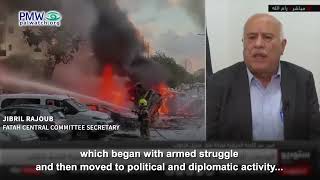
Senior PA leader Rajoub: "Resistance is Fatah's strategic right - in all its forms"
|
|
Source:
Palestinian TV (Fatah), Nov. 29, 2012
|
Fatah Central Committee member, Jibril Rajoub:
"Whoever invades our territory, will leave in a wooden plank (i.e., in a coffin). This land is our land... Out of loyalty to your blood, Yasser Arafat, you who died during this month, we will not return the sword to its sheath until there is a state... Resistance is Fatah's strategic right - in all its forms... We are ready - if there's shooting, we'll shoot. If there are demonstrations, we'll demonstrate."
Click to view video
Click to view bulletin |
|
|
|

|
|
PA daily columnist: "Armed resistance and popular resistance are one single resistance"
|
|
Source:
Al-Hayat Al-Jadida, Nov. 23, 2012
|
Columnist for official PA daily Yahya Rabah:
“The message that came through clearly from the heart of the [battle] field, and from the heart of the hot resistance is a message – supported by actual proof –stressing that our people is one; the project to bring about the liberation, the independence, and the building of the state, is one single project; their armed resistance and the popular (i.e., non-violent) resistance, are one single resistance; and the path and destiny of [the nation] in the West Bank, in the Gaza Strip, and in Jerusalem, are the same single path and destiny.”
|
|
|
|

|
|
|

|
|
Fatah official: "Every phase has a particular form of resistance" and armed resistance is still an option
|
|
Source:
Wattan TV website, Oct. 8, 2012
|
PA TV host: "Have the Palestinians, or the PLO, removed from their lexicon the term 'revolution,' in the sense of armed revolution?"
Member of the Fatah Central Committee, Mahmoud Al-Aloul: "No. No one has eliminated armed struggle or resistance as an option. Recently, at the last Fatah conference, there was an important declaration in the Introduction to the Political Program that we considered an integral part of the Political Program and whose important points stated that Fatah, for example, is a national liberation movement, and that Fatah believes that resistance, in all its forms, is the legitimate right of occupied nations when confronting their occupiers. I do not think that there's a single Palestinian who has eliminated resistance, or any form of resistance whatsoever, from consideration, or from his plans. That's in principle and in theory. We have to understand this well: Every form of resistance has certain conditions that are necessary for its use. So every phase has a particular form of resistance best suited to it, and everyone has agreed that at this stage, that form is popular resistance (i.e., non-violent). At the same time, armed resistance has absolutely not been eliminated from anyone's options. It needs a suitable climate not only among us... We hope that what is being spoken of as the "Arab Spring" and changes in the Arab world will create the climate so that the Palestinians can employ it (i.e., armed resistance)."
Click to view video
Click to view bulletin |
|
|
|

|
|
Non-violent struggle is "no less important than armed struggle"
|
|
Source:
Al-Hayat Al-Jadida, Sept. 2, 2012
|
Headline: "International lawyer Jonathan Kuttab in meeting on Wednesday – the non-violent struggle, which is being maligned, must become our principal means…"
"Participants in a meeting on Wednesday reacted enthusiastically to guest [speaker], international attorney Jonathan Kuttab, an expert on non-violent struggle. [Kuttab] reviewed the significance of this [type of] struggle, which in his opinion is 'maligned'… Kuttab said that non-violent struggle is a means of struggle no less important than armed struggle – neither in terms of training and preparation, nor in terms of effectiveness and results – in conditions like those of the Palestinian nation. This is because, in view of the unfortunate condition of our cause, popular resistance is the means, perhaps the only means, of the non-violent struggle that will prove feasible and effective. He explained that sometimes, many people misunderstand non-violent struggle, believing it to be a sort of ceasefire, surrender, or [attempt] to avoid real battles. However, in reality, non-violent struggle is not just refraining from violent means, for it is a multifaceted ideological system based on foundations that differ from – and sometimes are the opposite of – armed struggle. If the armed or military struggle demands the destruction of as many enemy installations as possible while limiting loss of life on one side, the opposite is true of the non-violent approach to struggle: the death of as many victims as possible among the oppressed side (i.e., the Palestinian side) serves to strengthen it, while civilian deaths among the enemy (i.e., among Israelis) diminishes the legitimacy of its struggle."
|
|
|
|

|
|
Fatah official glorifies terrorists as “Martyrs,” praises principle of alternating violence with negotiations
|
|
Source:
Palestinian TV (Fatah), July 8, 2012
|
PA TV live broadcast of ceremony commemorating anniversary of the death of Ghassan Kanafani – Tulkarem.
Mohammad Shtayyeh, member of the Fatah Central Committee:
"We, of the Fatah movement, do not cry over Martyrs. It is natural that a fighter should die as a Martyr, [as did] Abu Jihad, Abu Iyad, the Martyr, the symbol Yasser Arafat, and thousands more. But what makes Ghassan Kanafani special is that he died as a Martyr early on, like the Martyrdom-seekers Kamal Adwan, Kamal Nasser, Abu Yusuf Al-Najar, and Abu Ali Iyad…
Today we recall Hani Al-Hassan, who said: 'Military action seeds, and political action reaps.'"
Note: Abu Jihad (Khalil Al-Wazir) was a founder of Fatah and deputy to Yasser Arafat. He headed the PLO terror organization's military wing and planned many deadly Fatah terror attacks, including the most lethal in Israeli history, the hijacking of a bus and killing of 37 civilians, 12 of them children.
Abu Iyad (Salah Khalaf) was a founder of Fatah and Head of the Black September terror group. Attacks he planned included the murder of two American diplomats, as well as the murders of 11 Israeli athletes at the Munich Olympics in 1972.
Ghassan Kanafi was a writer and a leader of the Popular Front for the Liberation of Palestine.
Kamal Adwan was responsible for Fatah’s terrorist operations and a senior member of Black September. He and Kamal Nasser were killed by Israeli forces in April 1973.
Abu Yusuf Al-Najjar was Arafat's deputy, and commander of operations for the Black September organization. He was killed by Israeli forces in April 1973.
Abu Ali Iyad was appointed head of Fatah military operations in 1966, and was responsible for several terror attacks.
|
|
|
|

|
|
Fatah leader: “Fatah believes that the resistance in all its form” is a “legitimate right”
|
|
Source:
Palestinian TV (Fatah), Jan. 26, 2012
|
PA TV program Special Interview devoted to the fourth anniversary of the death of George Habash.
Studio guests: Fatah Central Committee member Mahmoud Al-Aloul; Deputy Secretary General of the Popular Front, Abd Al-Rahim Malouh; and member of the Palestinian National Council, Azmi Al-khahwaja.
Al-Aloul: "Fatah believes that the resistance, in all its forms, is the legitimate right of occupied nations in the face of their occupiers. Right now, in implementation, we say that every stage has its [appropriate] form."
PA TV host: "Of course; it's a new stage."
Al-Aloul: "The broadening of the margins of [political] maneuvering sometimes make it difficult for others to understand one correctly, but that is the reality."
|
|
|
|

|
|
PLO official: Popular resistance is appropriate “right now,” but “all forms of resistance” are a “legitimate right”
|
|
Source:
Palestinian TV (Fatah), Jan. 12, 2012
|
PA TV News:
Wasil Abu Yusuf, Secretary General of the Palestine Liberation Front and member of the PLO Executive Committee:
"Popular resistance is the appropriate form [of struggle] right now, within the framework of the Palestinian people's resistance to the occupation, settlements, and the [security] fence, along with an emphasis on [the fact] that all forms of resistance are a legitimate right of the Palestinian people."
|
|
|
|

|
|
DFLP leader: “The PLO has not ruled out the armed struggle”
|
|
Source:
Al-Hayat Al-Jadida, Jan. 10, 2012
|
| "Member of the Democratic [Front for Liberation of Palestine] central leadership, Sayel Khalil, said [during workshop held by the Struggle Front and the Political National Guidance in Tulkarem] that… the PLO has not ruled out the armed struggle and the Palestinian national struggle in its many forms, [chosen] in accordance with the [needs of] the period. He noted that we have a unified national strategy that fits the interests of our people in accordance with the [current] Political phase." |
|
|
|

|
|
Fatah official: “If the Israeli side refuses peace, then all the options are open to our people”
|
|
Source:
Al-Hayat Al-Jadida, Jan. 8, 2012
|
| "Member of the Fatah Central Committee, Jamal Muhaisen delivered greetings from the President [Abbas], the central committee and the revolutionary council… emphasized that our people and its leadership seek peace. He said, 'If the Israeli side refuses peace, then all the options are open to our people…' … Muhaisen addressed Israel, saying: 'We are a people that will not raise a white flag, because we are a fighting people. You have an opportunity to be part of the region. If not, your fate will be like the fate of all the invasions of Palestine, all of which ended in defeat.'" |
|
|
|

|
|
Official speaking in Abbas’ name: Fatah’s program of "struggle” will not change, “resistance in all its forms” is a “right”
|
|
Source:
Al-Hayat Al-Jadida, Jan. 5, 2012
|
"The Ramallah and El-Bireh branch of Fatah held an official and popular central rally to mark the occasion… attended by member of the Fatah Central Committee Mahmoud Al-Aloul, representing President Mahmoud Abbas… In a speech he delivered on behalf of the President, Al-Aloul said: 'On this day, when some pioneers from among our people stepped forward, believing in their Lord and the ability of their people to sacrifice, and refusing submission and oppression – there was an outbreak [of the Fatah revolution], there was the first bullet, there was Fatah…'
Al-Aloul stated that since its inception, the [Fatah] movement has adopted a clear program pertaining to the struggle and to social issues, which it will not change, based on the armed struggle and the people's long-term war. It continued with this and adhered to this, because it [the Fatah movement] believes that resistance in all its forms is the legitimate right of occupied peoples… He emphasized that the leadership, led by President Mahmoud Abbas, has made every effort, offered every opportunity to seek peace, and cooperated with every initiative… Al-Aloul said that 2012 is the critical year of the popular resistance. He called upon Fatah members to participate in it in order to deal with the Israeli aggression. He emphasized, 'We can no longer restrain the villagers, the residents and the youth in their resistance. The popular resistance will erupt alongside the political activity, whose aim is to earn the world's [support], to lay a siege against the Israeli policy, and to isolate the occupation."
|
|
|
|

|
|
Fatah official: Fatah supports “ongoing armed struggle” (i.e., violence) as well as “popular struggle”
|
|
Source:
Palestinian TV (Fatah), Jan. 4, 2012
|
Rally marking 47th anniversary of the Palestinian revolution, broadcast from Ramallah:
Fatah Central Committee member Mahmoud Al-Aloul:
"This movement from the outset presented a clear program for social struggle, and has not changed it to this day. It is a program of struggle which is based on ongoing armed struggle and popular struggle. This is what [the movement] has consistently upheld completely, to this day.
Did we not present a new political program, in which the Fatah movement believes that the struggle in all its forms is the legitimate right of occupied peoples in standing up to their occupiers? But every stage has its own form of struggle. You remember when you called the Martyr (Shahid) Khalil Al-Wazir 'the first bullet, the first stone'? When he turned to the stone, he did not rule out the possibility of the bullet. That is Fatah."
Note: Abu Jihad (Khalil Al-Wazir) – one of the founders of Fatah and deputy to Yasser Arafat. Headed PLO’s military wing. Planned many deadly Fatah terror attacks, including the most lethal in Israeli history, the hijacking of a bus and killing of 37 civilians, 12 of them children. |
|
|
|

|
|
Fatah has a right to all forms of struggle, including armed struggle
|
|
Source:
Al-Hayat Al-Jadida, Jan. 1, 2012
|
Excerpt from a long article about Fatah by Bakr Abu Bakr, marking 47th anniversary of the start of Fatah's activity. The article, occupying a full page, is printed against the background of the Fatah logo. Writer refers to Israel as the 'Zionist enemy'.
Headline: "Fatah is winning through activity and the masses"
"The [Fatah] movement emphasizes its right to engage in all forms of the struggle, as approved by international laws - including the armed struggle. It has chosen, at the present stage, the mass struggle, popular struggle, or peaceful struggle as the direction of the struggle."
Note: The PA has claimed for many years that all its terror is justified by international law. This is a reference to UN resolution 3236, which "recognizes the right of the Palestinian people to regain its rights by all means in accordance with the purposes and principles of the Charter of the United Nations." However, the resolution goes on to state that the use of "all means" should be "in accordance with the purposes and principles of the Charter of the United Nations..." The UN Charter prohibits targeting civilians, even in war. |
|
|
|

|
|
Fatah official: Popular resistance and armed resistance both be used in their “proper place”
|
|
Source:
Palestinian TV (Fatah), July 1, 2011
|
Program about Palestinian - Fatah-Hamas reconciliation and the appointment of a transitional Prime Minister.
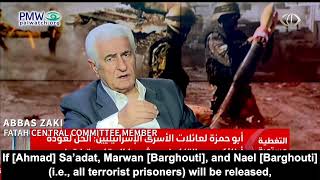
Guests: Abbas Zaki, member of the Fatah Central Committee
From studio in Gaza: senior Hamas official Ismail Radwan
PA TV host: ”In other words, resistance is sacred. [So] you would agree with this principle: ’Resistance is the right of the Palestinian people, a sacred right, but weapons are not sacred, and every situation has its own circumstances and its own timing’?”
Radwan: ”I say to you that it’s not a matter of weapons or no weapons. Weapons are sacred when I use them against the occupation, which knows only the language of force. So while the popular resistance has been good (i.e., effective), at the same time the armed resistance has also been good. I tell you honestly, we [Hamas and Fatah] may well agree on organizing the resistance, whether popular or armed or in all other forms of resistance -”
[Host allows Zaki to respond]
Zaki: ”Firstly, I agree with him that popular resistance, against the backdrop of the current situation, does work, and [the security fence route adjustment around] Bil’in proves that it’s an effective means which can achieve results. However, we the Palestinian people – [UN General Assembly] Resolution 3236 gives the Palestinian people the right to use all means of struggle, including the armed struggle. But the use of the armed struggle requires a [certain] atmosphere, it requires internal order, it requires that using it will be of great benefit to you and will carry a heavy price for the enemy. Unfortunately, all of this is absent.”
|
|
|
|

|
|
Armed struggle is "impossible under current conditions," but "moment of resistance" will arrive
|
|
Source:
Al-Hayat Al-Jadida, May 11, 2011
|
Adli Sadeq, PLO Ambassador to India and regular columnist for official PA daily:
“On the Palestinian level, no one disagrees that the armed struggle is difficult, or impossible, under current conditions. Our obligation right now is to prevent the violation of our commitment to a work plan which will maintain public order, protect society from disruptions, and allow the political players to compensate for the abstention from the most noble means of resistance (when it is strategically possible) –i.e., the armed struggle – by means of advantages and achievements in our political standing. …
The armed forces and groups, wherever they may be, must gather together under the flag of the national entity, with their weapons and with their vision, and must willingly forego their ability to coerce on the internal level. The use of resistance as an excuse is not convincing; Palestinian experience has show us that when the moment of resistance arrives, whether the estimates are mistaken or accurate, it is the legitimate leadership that will be on the frontlines, and that is who will push society into the conflict – as happened in the lengthy Second Intifada, when the security services and Hamas fought together.”
|
|
|
|

|
|
PA daily coumnist: Our obligation right now is to abstain from armed struggle (violence)
|
|
Source:
Al-Hayat Al-Jadida, May 11, 2011
|
| “On the Palestinian level, no one disagrees that the armed struggle is difficult, or impossible, under the current conditions. Our obligation right now is to prevent the violation of our commitment to a work plan which will maintain public order, protect society from disruptions, and allow the political players to compensate for the abstention from the most noble means of resistance (when it is strategically possible) –i.e., the armed struggle – by means of advantages and achievements in our political standing. … The armed forces and groups, wherever they may be, must gather together under the flag of the national entity, with their weapons and with their vision, and must willingly forego their ability to coerce on the internal level. The use of resistance as an excuse is not convincing; Palestinian experience has shown us that when the moment of resistance arrives, whether the estimates are mistaken or accurate, it is the legitimate leadership that will be on the frontlines, and that is who will push society into the conflict – as happened in the lengthy Second Intifada, when the security services and Hamas fought together.” |
|
|
|

|
|
Fatah spokesman: "We want to die as Shahids [Martyrs] in exchange for political profit"
|
|
Source:
Palestinian TV (Fatah), May 4, 2011
|
Fatah spokesman Osama Al-Qawasmi:
“If resistance [violence] doesn’t serve the Palestinian political project, then it’s a crime against us. We don’t want resistance for the sake of resistance, we don’t love death, we want life, and when we die as Shahids (Martyrs) we want to die as Shahids in exchange for political profit which all of us are able to realize.” |
|
|
|

|
|
Palestinian strategy is to engage in both diplomacy and violence
|
|
Source:
Al-Hayat Al-Jadida, Apr. 10, 2011
|
Official PA daily columnist, Adli Sadeq:
"When the results [of the Al-Aqsa Intifada] forced us to return to the option of politics and national resolve upon the land, unity was withheld from us with various excuses, and we found ourselves divided, with one of the strategic aims of the occupiers having been, and still being, to destroy our ability to realize the two opposite options: politics (i.e., diplomacy) and resistance (i.e., violence)!” |
|
|
|

|
|
PA daily columnist opposes violent resistance, but only because it is ineffective
|
|
Source:
Al-Hayat Al-Jadida, Mar. 14, 2011
|
Muwaffaq Matar in his column, from article “A Question along the Way:”
Headline: “Netanyahu is gambling with Jewish children”
"We dare not return to armed activity. We believe that it is no longer appropriate in our situation and in our reality, since the non-violent popular resistance is more effective. We aim for alertness and caution – not only regarding the danger of falling into a trap where our resistance becomes terrorism and crime, in light of the rise in official and popular worldwide support for our non-violent and legitimate struggle, but out of concern for ourselves and at ourselves, because justice is with us so long as human values guide every movement in our lives. Just as our aspiration for freedom, liberty and independence is a right, [so] we take care to purify our path and our means from the desire for revenge or submission to the Satan of murder for the sake of murder.” |
|
|
|

|
|
Fatah leader: Armed resistance is a right but is not currently possible
|
|
Source:
Al-Hayat Al-Jadida, Feb. 2, 2011
|
Nabil Shaath is a member of the Fatah Central Committee and Fatah’s Commissioner of International Relations:
“During a political gathering held by Fatah – Tubas branch, under the heading, “The Principles are our Bridge to a State”, Shaath noted that the American administration and Israel are applying pressure to the Palestinian leadership to return to negotiations. He said, ‘However, we decided that our present strategy will be a continuation of the popular struggle in all its forms and through all its means; a launching of international activity in order to obtain further international recognition of a Palestinian state; and pursuit of Israel and war criminals in international forums.’…
Shaath noted that the leadership is opposed to the idea of returning to negotiations without a change in the balance of power on the ground. He added that right now there is no room for the realization of our people’s right to armed resistance, due to several considerations and the results that it might bring about on the ground.”
|
|
|
|
|
|
|
|
|
|
|
|