



The Pay-for-Slay deception: Three statements expose the Palestinian Authority’s fake "welfare" reforms
Terrorist prisoners have a right to salaries regardless of need - Palestinian human rights lawyer
"We are trying to find another way to transfer the salaries to our Martyrs and wounded" - Fatah spokesman
Terrorist salaries are "social welfare" not "Pay for Slay" - Fatah spokesman
While the Palestinian Authority publicly claims it has altered its controversial payment of rewards to terrorists into a need-based social welfare program to appease international critics, internal statements and legal realities reveal that the Pay-for-Slay infrastructure remains intact.
The disconnect between the PA's outward diplomatic rhetoric claiming to have ended its terror salaries and its internal mechanisms to ensure their continued payment is demonstrated in three recent statements.
The active workarounds
Rather than dismantling the system, Palestinian officials are actively looking for loopholes to bypass financial restrictions. Fatah spokesman Mundhir Al-Hayek openly admitted that despite Israel deducting tax funds to block these payments, the PA is "trying to find another way to transfer the salaries to our Martyrs and wounded":
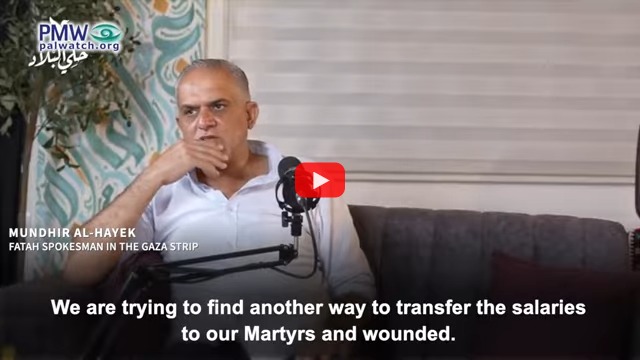
Fatah Spokesman in the Gaza Strip Mundhir Al-Hayek: "Why did it [Israel] steal the tax money? (i.e., Israel's law to deduct terror salaries) - So that we stop the salaries of the Martyrs, prisoners, and wounded (i.e., terrorists). There is the issue of salaries. We are trying to find another way to transfer the salaries to our Martyrs and wounded."
[The Story of the Land podcast, Oct. 23, 2026]
The diplomatic face
In response to US visa denials over the PA's payments to terrorists, Fatah Spokesman in Europe Jamal Nazzal defended the system, asserting that PA Chairman Mahmoud Abbas implemented a "unified system for social protection" based strictly on financial need rather than rewards for terror against Israel:
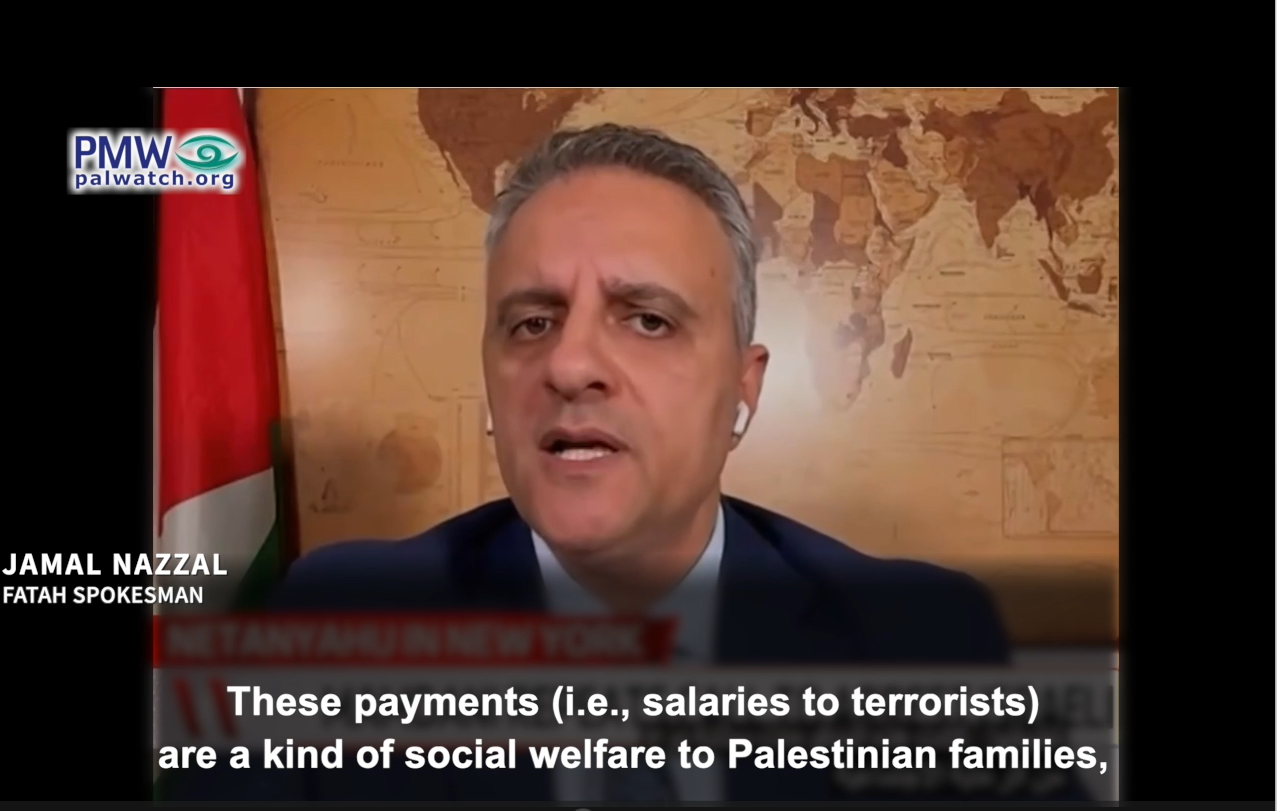
Al-Arabiya TV host: "Washington says it denied your [Palestinian] delegation visas and Mahmoud Abbas to attend the UN over [the PA's] legal action against Israel [at the ICC], payments to prisoners' (i.e., terrorists') families and PLO activities. What is your response? …"
Fatah Spokesman Jamal Nazzal: "I'll refer them to what Mr. Abbas just said in his speech [to the UN]. He talked about the unified system for social protection and welfare based on needs. All [PA] laws and regulations that are contrary to this had been altered and it has been implemented. These payments (i.e., salaries to terrorists) are a kind of social welfare to Palestinian families, because Israel has arrested tens of thousands of Palestinian individuals (i.e., terrorists) or killed dozens of thousands Palestinian individuals (i.e., terrorists) and their families have to be supported. It's not like they [Israel] portray it."
[Fatah Spokesman Dr. Jamal Nazzal, Facebook page, Sept. 24, 2026]
The legal reality
This claim of a "need-based" shift is flatly contradicted by Palestinian legal analysts. Ahmad Nasra, a legal advisor for the Independent Commission for Human Rights, noted that a recent legal petition explicitly challenges the need-based criteria, pointing out that the Palestinian Basic Law fundamentally grants imprisoned terrorists an absolute right to salaries "regardless of whether they are needy or not:"
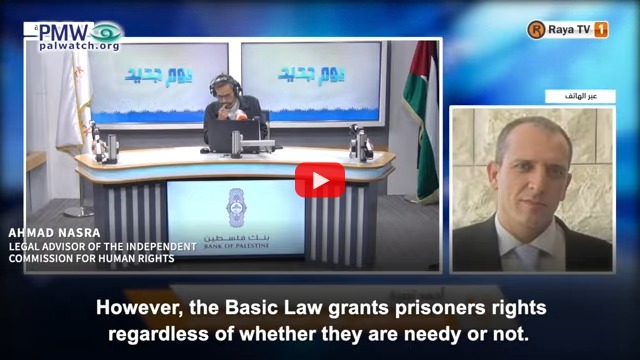
Legal advisor of the Independent Commission for Human Rights, Ahmad Nasra: "[The petition regarding prisoners' salaries] relies on the existence of a fundamental right for prisoners (i.e., terrorists) established in the [Palestinian] Basic Law, granting them allowances or financial assistance or salaries without any other conditions. Currently, the [Palestinian National] Institution for Economic Empowerment [PNEEI] asks every person, whether he is a prisoner or not, to submit proof of need. However, the Basic Law grants prisoners rights regardless of whether they are needy or not."
[Raya News Network (Independent Palestinian News Network), Oct. 12, 2026]
Together, these statements reveal that the PA's "social welfare" rebranding is merely a diplomatic cover, while the institutional commitment to unconditionally funding terrorists continues behind the scenes.