






Terror supporters got most votes at conference, says poli-sci lecturer on Palestinian Authority TV
Palestinian Media Watch has shown how Palestinian terrorists have been elevated by the Palestinian Authority/Fatah to be heroes and role models for Palestinian society. The Eighth Fatah Conference a few days ago confirmed this once again.
The more a candidate supported terror, the better his/her chances were of becoming a member of Fatah's Central Committee. This was the blunt explanation given on official PA TV by a guest who analyzed the results of the elections held at the conference.
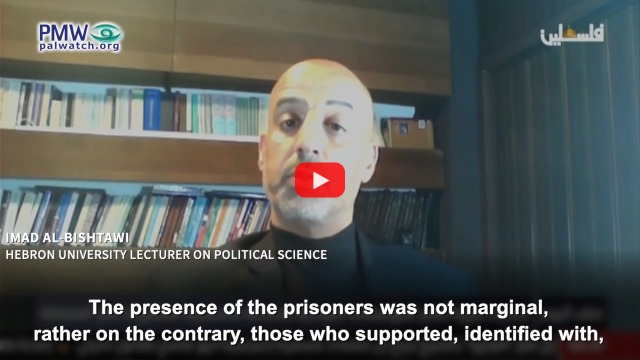
Official PA TV host: "Regarding the prisoners' (terrorists') movement, both those who have become released prisoners and those among them who are still being held in the occupation's (i.e., Israeli) prisons – what is the importance of their participation [in the Eighth Fatah Conference], their election [to the Fatah committees], the mentioning of their names, and the expression of trust in them?"
Hebron University lecturer on political science Imad Al-Bishtawi: "The presence of the prisoners was not marginal, rather on the contrary, those who supported, identified with, and expressed solidarity with the prisoners' issue (i.e., terror supporters) actually succeeded in winning votes, [since] the prisoners sense who stood by them, who supported their issue, and who expressed solidarity with them, and therefore they gave him this trust, and also attributed to him credibility so that he would be elected as a member of the Central Committee."
[Official PA TV, Topic of the Day, May 18, 2026]
According to Al-Bishtawi, the participation of released terrorist prisoners at the conference was not symbolic or marginal. On the contrary, their presence had a direct political impact. Because so many released prisoners took part in the conference and voted, they were able to reward the candidates who had been most loyal to them, most supportive of their cause, and most openly identified with them.
In other words, support for imprisoned and released terrorists was an electoral asset.
Al-Bishtawi explained that the prisoners "sense who stood by them" and who showed "solidarity" with them. Those candidates, he said, were then granted the prisoners' "trust" and "credibility" and were elected to Fatah's Central Committee.
This means that the released terrorist prisoners who participated in the Eighth Fatah Conference helped shape Fatah's future leadership by elevating those who had proven themselves as champions of the prisoners' issue, which is the PA and Fatah euphemism for imprisoned terrorists, including murderers.
The statement is significant because it confirms what PMW has repeatedly documented: In Fatah and the Palestinian Authority, terrorist prisoners are treated as a powerful political constituency whose approval can help determine who rises to the top of the movement.
Al-Bishtawi's answer exposed the internal logic of Fatah politics—those who support terrorists gain political credibility. Those who stand with the "prisoners' issue" gain votes. And those who win the backing of terrorist prisoners can be rewarded with positions in Fatah's senior leadership.
This is the political culture that Palestinian Authority Chairman Mahmoud Abbas' Fatah movement showcased at its Eighth Conference: Released terrorist prisoners were not pushed aside. They were empowered, their influence was welcomed, their cause was celebrated, and their supporters were elected.